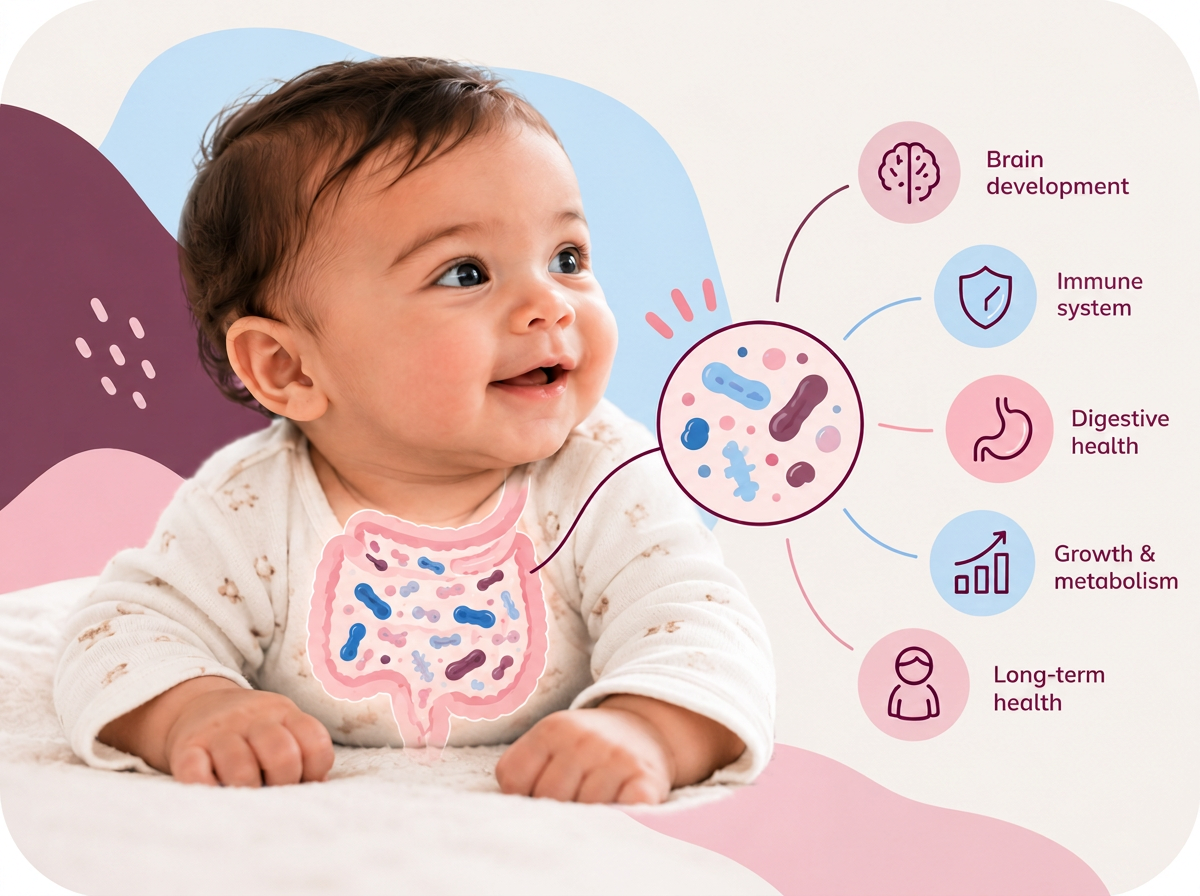
Could a baby’s gut hold clues to their future health?
The infant gut microbiome develops rapidly after birth, shaped by a range of influences from pregnancy through to a child’s second birthday.
The 1001 Critical Days Foundation is funding new research at the University of Birmingham Dubai to understand what shapes the infant gut microbiome and how it may be linked to children’s health and development.
Led by Dr Adam McNeill, the research is now under way, with findings expected in spring 2027. By bringing together existing evidence, the project aims to identify what we know, where important questions remain and how the findings could inform future support for babies and families.
Why does the infant gut microbiome matter?
The gut microbiome is the community of microorganisms, including bacteria, that live in the digestive tract. These microorganisms play a role in digestion and interact with other developing systems in the body, including the immune system and metabolism.
Researchers are exploring whether differences in the infant gut microbiome are associated with later health outcomes, including allergies, gastrointestinal health, metabolic health, growth and neurodevelopment.
However, an association does not necessarily mean that one factor causes another. The science is evolving, and more work is needed to understand which relationships are well supported by evidence and which remain uncertain.
Understanding the strength and limitations of the research is an important step towards building a clearer picture of early childhood development and the potential implications for babies’ health.
What shapes a baby’s gut microbiome?
A baby’s gut microbiome develops rapidly after birth, influenced by factors including maternal health and diet during pregnancy, mode of birth, antibiotics, infant feeding and the wider environment.
Many of these influences occur during the 1,001 critical days, a period of rapid development when a baby’s brain, immune system, metabolism and other biological systems are developing alongside the gut microbiome.
The research will examine which factors are most consistently associated with microbiome development, how strong the evidence is and which questions need further investigation.
What is our research investigating?
The Foundation has commissioned an umbrella systematic review of research into the infant gut microbiome during the 1,001 critical days.
An umbrella review brings together findings from existing systematic reviews, meta-analyses and other high-quality evidence syntheses. Rather than examining individual studies in isolation, it allows researchers to compare findings across a wider body of research and assess the overall strength and consistency of the evidence.
The project will explore three key questions:
1. What influences the development of the infant gut microbiome?
2. What are the potential links between the infant gut microbiome and child health?
3. What does the evidence mean for early years policy, professional practice and family support?
The review will distinguish between robust, emerging, limited and inconsistent evidence. It will also consider the difference between association and causation, helping to avoid conclusions that go beyond what the science can demonstrate.
By assessing the strength and limitations of the findings, the research aims to identify where the evidence could help inform future research, professional education, public health guidance and support for families.
Why are we funding this research?
The 1,001 critical days are an extraordinary period of development, with potential implications for health and wellbeing throughout childhood and beyond.
Research into the infant gut microbiome is growing, but findings are spread across many different studies and reviews. This makes it difficult to see the overall picture and identify where the strongest evidence lies.
By bringing this research together through the lens of the 1,001 critical days, we aim to build a clearer understanding of what is known, what remains uncertain and where further attention is needed.
The aim is not to make assumptions about what families should do or to place responsibility on parents for a baby’s health. Instead, the research will help establish a clearer evidence base that can support informed conversations about early development, healthcare, public health and family support.
Ultimately, the review could highlight gaps in our understanding of infant gut health and begin to lay a roadmap for future research, intervention development and policy impact.
Who is conducting the research?
The project is being carried out by a team at the University of Birmingham Dubai, bringing together expertise in health psychology, public health, early-life development and systematic review methods.
The team will systematically examine existing reviews, assess their quality and compare fundings using recognised research methods.
The findings will be shared through accessible resources, including an executive summary, briefing paper and visual framework, to help professionals, policymakers and wider audiences understand the evidence.
When will the research be available?
The project began in September 2026, with the review expected to be completed in spring 2027. The findings are intended to inform future discussion and understanding of the infant gut microbiome and its potential relevance to early childhood health and development.
As the research progresses, the Foundation will share further information about the findings and what they may mean for professionals, policymakers and families.
Explore our research
At the 1001 Critical Days Foundation, we fund research that strengthens understanding of pregnancy, infancy and early childhood, helping to identify where evidence can support better outcomes for babies and their families.
Explore our other research projects to discover how we are supporting evidence-led work across the 1,001 critical days.